Army talk is full of abbreviations, Malay commands and words that make no sense before enlistment.
This is the quick dictionary. For insignia and forms of address, see SAF ranks. For parade language, see marching commands.
Common terms people search for
What does saikang mean?
Saikang means an annoying or menial job nobody wants to do. Think moving stores, washing vehicles, raking leaves or doing random jobs for Encik.
What does POP mean in NS?
POP means Passing Out Parade. It marks the end of BMT. You are still an NSF after POP, but you move on to command school or your vocation.
What does PTP mean in NS?
PTP means Physical Training Phase. It is the extra eight weeks before BMT for PES A or B1 enlistees who did not clear the required pre-enlistee IPPT score.
What do SBO and FBO mean?
SBO means Skeletal Battle Order. It normally includes your helmet, Load Bearing System and rifle.
FBO means Full Battle Order. It normally adds your field pack to the SBO load.
Some units use terms such as SBO 0 or SBO 1 for different load states. The exact packing list can differ, so follow what your commanders give you.
What does SOL mean in NS?
SOL means Stoppage of Leave. It is a punishment where you cannot leave camp for a set number of days.
What does coy mean in the army?
Coy is short for company. In BMT, a company is split into platoons, and each platoon is split into sections.
What does ASA mean in NS?
ASA means Admin Support Assistant. It is the SAF clerk vocation, covering personnel, records and other office work. See the logistics vocation guide for the difference between an ASA and a Supply Assistant.
What does OOC mean in NS?
OOC means Out of Course. You stop your current course, usually because of medical, training or administrative reasons. What happens next depends on the course and why you OOC.
What does upperstudy mean?
Your upperstudy is the person whose job you are taking over. They teach you the role before they ORD or move elsewhere. You become the understudy while learning from them.
NS and service
- NS: National Service. This covers full-time service and the Operationally Ready phase after ORD.
- SAF: Singapore Armed Forces.
- NSF: Full-time National Serviceman.
- NSman: An Operationally Ready National Serviceman who has completed full-time NS.
- ORD: Operationally Ready Date. Your last day of full-time NS.
- ORNS: Operationally Ready National Service. The reservist phase after ORD.
- ICT: In-Camp Training. Your NS unit calls you back for training after ORD.
BMT and training
- BMT: Basic Military Training. The first major training phase for most SAF enlistees.
- BMTC / BMT(C): Basic Military Training Centre. Usually what people mean when talking about Tekong BMT.
- BTP: Basic Trainfire Package. Your basic live-firing package during BMT.
- ATP: Advanced Trainfire Package. A later live-firing package after BTP.
- BIC: Battle Inoculation Course. A short exercise where recruits move through a simulated battlefield.
- CQB: Close Quarter Battle. Training for fighting in buildings and built-up areas.
- FTP: Field Training Programme. Training exercises conducted outfield.
- SIT test: Situational Test. A field exercise used to assess leadership for command school selection. See the SIT test guide.
- SCS: Specialist Cadet School. Graduates normally become Third Sergeants.
- OCS: Officer Cadet School. Graduates normally become Second Lieutenants.
- SOC: Standard Obstacle Course.
- IPPT: Individual Physical Proficiency Test. The SAF fitness test covering push-ups, sit-ups and a 2.4 km run. See the IPPT guide.
- UIP: Unit Induction Programme. The introduction and training period after you arrive at a new unit.
- Outfield: Training outside camp, normally in field conditions. Expect less sleep, no shower and plenty of equipment.
Equipment and inspections
- SBA: Stand By Area. A bunk or area inspection.
- LBS: Load Bearing System. The vest and webbing used to carry equipment.
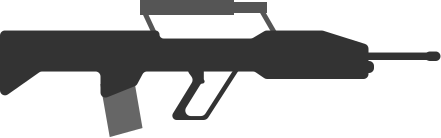
- SAR 21: Singapore Assault Rifle 21. The standard rifle most recruits train with.
- Force prep: Force preparation. Checking, laying out and packing equipment before an exercise or outfield.
- Turnout: An unplanned fall-in or equipment check, often at an inconvenient time. Move fast and bring what you were told to bring.
Medical and statuses
- PES: Physical Employment Standard. The medical grade used to decide training and vocation suitability. See the PES guide.
- MCS: Medical Classification System. It replaces PES for pre-enlistees enlisting from October 2027 onwards.
- MO: Medical Officer. The doctor you see when reporting sick in camp.
- RSI: Report Sick In-camp.
- RSO: Report Sick Outside.
- MC: Medical certificate. In NS, this normally means you are on Attend C and resting at home.
- Attend B / LD: Light duty. You still report for duty but are excused from activities covered by your status.
- Attend C: Excused from all duties. Depending on the situation, you may rest at home on MC or remain in the sickbay. See the Attend C guide.
Roles, ranks and discipline
- SA: Supply Assistant, commonly called a storeman.
- TO / TPT OPR: Transport Operator. An SAF driver.
- Spec: Specialist. Usually a sergeant who commands and trains soldiers.
- Encik: A common way to address a warrant officer. It literally means "uncle" in Malay, but do not use it casually for every older serviceman.
- SCT: Specialist Cadet. Someone training in SCS.
- 3SG: Third Sergeant. The first specialist rank after graduating from SCS.
- 2LT: Second Lieutenant. The first commissioned officer rank after graduating from OCS.
- AWOL: Absent Without Leave. Being away from duty without permission.
- DB: Detention Barracks. The military detention facility.
Army slang
- White horse: The son of someone influential who is suspected of receiving special treatment. An official SAF classification existed before 2000, although the Government said it was intended to prevent preferential treatment. See the full white horse explainer.
- Kenna: To get subjected to something, usually something bad. Example: "I kenna SOL."
- Bobo shooter: Someone who cannot shoot properly.
- Wayang: Putting on a show to impress commanders or look busier than you are.
- Rabak: Very bad, messy or exhausting. Example: "That outfield was rabak."
- Chao keng: Pretending to be sick or injured to avoid work. Do not use it for someone with a real medical issue.
- Drop / knock it down: Get into the push-up position.
- Semula: Undo the last drill movement and return to the previous position.
Common phrases
- Act blur, live longer: Pretend you do not know what is happening so you do not get picked for extra work.
- You think, I thought, who confirm?: What someone says when you give an answer based on an assumption instead of checking.
Unit structure
Smallest to largest:
- Soldier
- Section: usually 6 to 16 people
- Platoon: usually 2 to 6 sections
- Company: usually 2 to 4 platoons
- Battalion: multiple companies
- Brigade: multiple battalions
- Division: multiple brigades
In BMT, a section is usually around 16 recruits. Four sections form a platoon, and four platoons form a company. Exact numbers change between batches.